July 30, 20268 min read
How to Organize Client Tracking as a Dog Trainer
From first contact to client loyalty: how dog trainers organize client
PawTracker
From first contact to client loyalty: how dog trainers organize client
For several weeks now, I've been talking with dog trainers across the US, the UK, and Canada. One thing stood out: there's no single way to track dogs and clients. Some use Google Drive, others WhatsApp, a spreadsheet, a notebook... or just memory. And yet, everyone is chasing the same goal: keeping a clear history and supporting each dog over time.
What differs is the system. What's shared is the intent.
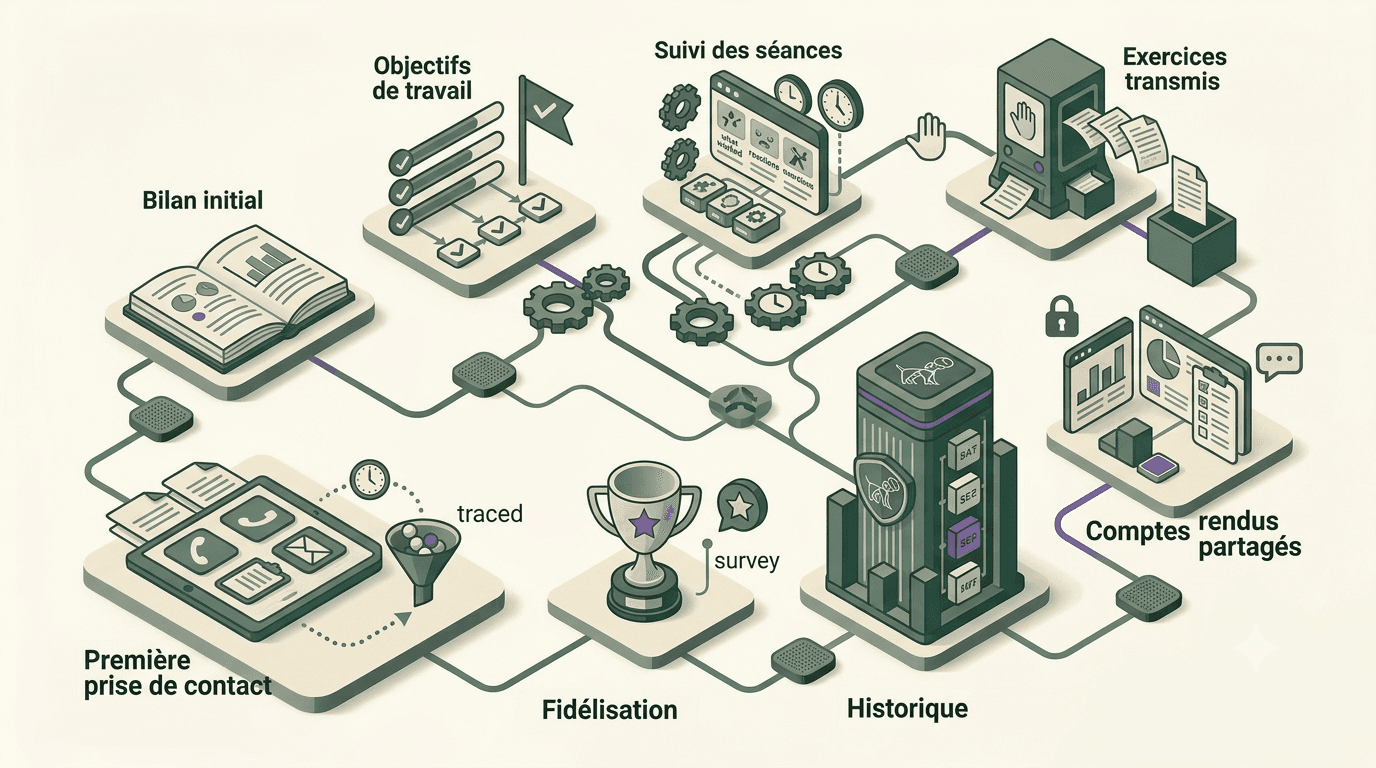
This isn't about prescribing one tool or one method. It lays out the stages of client tracking in dog training — from first contact through to loyalty — so you can build the system that actually fits how you work.
A dog trainer is, first and foremost, a hands-on professional. The expertise is the dog — not admin work.
So client tracking tends to build up by accumulation: a file created here, a message sent there, a note jotted on the phone after a session. It works at first. Sometimes for a long time. And then one day, something gets lost — a piece of information, some context, a bit of history — and you realize the improvised system has its limits.
Building structured tracking isn't admin for its own sake. It's what lets you support every dog properly, even as your client list grows.
It all starts before the first session. The owner reaches out — by email, phone, a form, Instagram. They have a request, sometimes vague, often loaded with unstated expectations.
That first exchange is worth recording. Not for the sake of running a CRM — but so you're not starting from scratch when they call back three weeks later, or so you can pull up what they told you about their dog before the assessment even happens.
Worth noting at this stage: reason for contact, type of dog, perceived urgency, channel used.
This is the foundational session. The one that sets the diagnosis, defines the goals, and establishes the relationship.
The assessment deserves its own space in your tracking — separate from later sessions. It's what gives context to everything that follows. If you pull it up six months later, you should be able to understand where this dog started in about two minutes.
A well-documented assessment includes: the dog's profile, initial behavioral observations, the owner's expectations, the goals set, and the first direction for the work ahead.
This is the step a lot of trainers skip — or just keep in their head.
Writing goals down creates a throughline for everything that follows. It lets you measure progress. It also lets you reset a conversation when an owner starts comparing their dog to others or getting impatient.
"We set this goal at the start — here's where we are now" only works if that goal was written down somewhere in the first place.
This is the core of client tracking — and often where systems fall apart.
After every session, there's valuable information left over: what was worked on, how the dog reacted, what's still resisting, what was surprising. If it's not noted quickly, it fades.
What the trainers I talked with consistently log after a session:
Not a novel. A few structured lines, noted while it's still fresh.
This might be the most underrated part of client tracking.
What an owner does — or doesn't do — between sessions largely determines how fast a dog progresses. And what they do depends directly on how clear the instructions were.
An exercise explained verbally fades within days. An exercise written down — with context, frequency, and what to avoid — stays accessible. The owner can reread it Thursday evening before practicing. They can show a partner. They can check it right before the next session.
That record of homework given also protects you if a question ever comes up about what was or wasn't communicated.
The report is the visible part of client tracking — the part the owner actually sees.
Its format varies from trainer to trainer: some send a structured message after every session, others put together a fuller document at key milestones (after the assessment, mid-program, at the end). Some adjust based on the client.
What shows up in the practices that work: a report focused on what's next, not just on what happened. Exercises to practice, the next step, one observation about the dog. Something actionable, not just a record. (For a deeper look at what makes a report actually useful between sessions, this is worth its own read.)
After a few months, a dog's tracking record becomes a genuinely valuable resource.
The full history — initial assessment, goals, sessions, homework given, reports sent — shows the ground covered. It lets you prep for the next session already knowing exactly where things stand. It lets you answer precisely if an owner ever questions their dog's progress.
That history is only valuable if it's accessible. Findable. Not buried in a WhatsApp thread or scattered across three different places.
Structured tracking is the best client retention tool that exists in dog training — and it's rarely framed that way.
An owner who regularly gets clear updates, who sees their dog's progress documented, who feels supported between sessions — that owner comes back. They refer others. They don't compare your rates to the trainer down the street.
Retention isn't extra effort. It's the natural result of tracking done well.
There's no universal answer. Here's what comes up most often in conversations:
A notebook or text file : simple, fast, no friction. Limited as soon as you have several active clients or need to find something specific in the history.
A spreadsheet (Excel, Google Sheets) : flexible, customizable. Takes some setup, and gets harder to maintain as volume grows.
Google Drive or Notion : lets you structure folders by client, share documents, centralize information. Needs disciplined organization to stay readable over time.
WhatsApp : used by almost everyone for the direct connection with owners. Rarely enough as a standalone tracking tool — information gets lost there fast.
Some professionals prefer to centralize all of this in dedicated software. The goal isn't just storing documents — it's being able to quickly pull up each dog's history, the goals that were set, the sessions completed, and the reports shared with owners. Tools like PawTracker were built with exactly that in mind.
Where do I start if I have no system in place? With the client file. Create a dedicated space for each dog — even something minimal — with the profile, goals, and sessions. That's enough to get started. Everything else structures itself naturally from there.
Do I need to document everything, or just the key points? The key points are more than enough. What you worked on, how the dog reacted, what was given to the owner, the next step. Five lines after every session is already solid tracking.
How do I follow up with clients who go quiet between sessions? A short check-in halfway through — "how are the exercises going?" — often surfaces sticking points an owner wouldn't have mentioned on their own. It's also a way to stay connected without being intrusive.
Does structured tracking actually change the results dogs achieve? Yes, indirectly. Well-kept tracking improves the continuity of work done at home, which speeds up the dog's progress. It also improves session prep — you walk in already knowing exactly where to pick up, which moves things along faster.
At how many clients does tracking actually become necessary? Most trainers start feeling the need for a system around five or six active clients at once. But building the habit early — from your very first clients — is always easier than trying to catch up on a backlog of history later.
There's no perfect system. There's just yours — the one you'll actually stick with, the one that fits how you work, and the one that lets you support every dog properly.
What the trainers I talked with have in common isn't the tool. It's the intent: keeping the thread. Never losing track of a dog. Staying present between sessions, even from a distance.
Organization isn't an administrative burden. It's an extension of the support you already give.